



When we flip a switch, plug in a charger, or hold a smartphone, we rarely stop to ask a simple yet powerful question: is plastic a conductor or insulator? The answer shapes the safety of our homes, the design of our devices, and even the future of advanced materials in modern science.
Electricity powers our world. From towering grids to tiny microchips, electrical flow must be carefully controlled. Some materials allow electricity to pass freely, while others block it. Understanding whether plastic conducts or insulates electricity is essential not only for students but also for engineers, designers, and curious minds who want to understand how everyday objects function.
This comprehensive article will deeply explore the question: is plastic a conductor or insulator? We will examine the science behind electrical conductivity, the molecular structure of plastic, comparisons with metals, real-world applications, safety implications, environmental impact, and even advanced conductive plastics used in modern technology.
Understanding Electricity Before Asking: Is Plastic a Conductor or Insulator?
Before answering the question is plastic a conductor or insulator, we need to understand what electricity actually is.
Electricity is the flow of electrons through a material. Electrons are tiny charged particles found in atoms. When these electrons move freely, the material is considered a conductor. When electrons are tightly bound and cannot move easily, the material acts as an insulator.
Conductors
Conductors allow electricity to pass through easily. Metals like copper and aluminum are excellent conductors because they have free-moving electrons.
Insulators
Insulators resist the flow of electricity. They prevent electrons from moving freely. Common insulators include rubber, glass, and — yes — plastic.
So at a basic level, the short answer to the question is plastic a conductor or insulator is:
Plastic is generally an insulator.
But the full story is more fascinating than a simple one-line answer.
The Molecular Structure Behind the Question: Is Plastic a Conductor or Insulator?
To understand why plastic behaves as it does, we must look at its molecular structure.
Plastic is made of long chains of molecules called polymers. These polymers consist mainly of carbon and hydrogen atoms bonded together. The electrons in these bonds are tightly held and do not move freely.
Unlike metals, plastics lack free electrons. In metals such as copper or aluminum, electrons form a “sea of electrons” that move easily throughout the structure. This movement allows electrical current to flow.
In plastic, electrons are locked within molecular bonds. Because of this structure:
- Plastic does not allow free electron movement.
- Electrical current cannot easily pass through it.
- It resists electricity.
Therefore, from a structural standpoint, plastic is an insulator.
Comparing Plastic with Metals: Is Plastic a Conductor or Insulator?
Let’s compare plastic with common conductive materials.
Example of Conductive Metal: Copper
Copper is widely used in electrical wiring. Why?
- It has free-moving electrons.
- It has low electrical resistance.
- It efficiently carries electrical current.
Now compare that to plastic:
- Plastic has tightly bound electrons.
- It has very high electrical resistance.
- It blocks electrical current.
This stark contrast explains why electrical wires often have a copper core and a plastic outer coating. The copper conducts electricity. The plastic prevents accidental shocks.
So when asking is plastic a conductor or insulator, comparing it to copper makes the answer very clear: plastic is an insulator.
Why Is Plastic Used to Cover Electrical Wires If It Is Not a Conductor?
This is one of the strongest real-world proofs answering the question is plastic a conductor or insulator.
Electrical wires are usually coated with plastic materials like:
- PVC (Polyvinyl Chloride)
- Polyethylene
- Rubber-like polymers
The purpose of this coating is to:
- Prevent electric shock
- Stop short circuits
- Protect users from exposed conductive metals
If plastic were a conductor, it would not be safe to touch electrical cords. The fact that we safely handle plastic-coated wires every day confirms that plastic acts as an insulator.
Electrical Resistance and the Question: Is Plastic a Conductor or Insulator?
Electrical resistance measures how strongly a material opposes electrical flow.
- Conductors have low resistance.
- Insulators have high resistance.
Plastic has extremely high resistance compared to metals. In fact, its resistance is millions of times higher than that of copper.
This high resistance:
- Blocks electric current
- Reduces energy flow
- Protects users from shocks
Thus, resistance data further confirms that plastic is an insulator.
Are There Any Exceptions? Is Plastic Always an Insulator?
Here is where the question is plastic a conductor or insulator becomes more advanced.
While most plastics are insulators, scientists have developed conductive plastics.
Conductive Polymers
Certain plastics can be chemically modified to conduct electricity. These are known as conductive polymers.
One famous example is:
- Polyaniline
Conductive polymers work differently than metals. Instead of having free electrons like copper, their molecular structure is altered so electrons can move along the polymer chain.
These special plastics are used in:
- Flexible electronics
- Organic solar cells
- Touchscreens
- Wearable technology
However, it is important to note:
Regular everyday plastic is still an insulator.
Conductive plastics are specially engineered materials, not typical household plastics.
Static Electricity and Plastic: Does That Change the Answer?
You may have noticed that plastic can build up static electricity. For example:
- Rubbing a balloon on hair
- Plastic combs attracting small paper pieces
Does this mean plastic is a conductor?
No.
Static electricity happens because plastic holds electric charges on its surface. Since plastic does not allow electrons to move freely, the charge remains stuck in one area instead of flowing away.
In fact, plastic’s insulating nature makes static electricity possible. If plastic were conductive, charges would immediately dissipate.
So static electricity actually supports the idea that plastic is an insulator.
Thermal Conductivity vs Electrical Conductivity
Sometimes people confuse heat conduction with electrical conduction.
Plastic is also generally a poor conductor of heat. That’s why:
- Cooking utensils often have plastic handles.
- Electrical tools use plastic grips.
- Insulated cups use plastic layers.
Metals transfer heat quickly. Plastic does not.
Thus, both electrically and thermally, plastic behaves as an insulator.
Real-Life Applications That Answer: Is Plastic a Conductor or Insulator?
Let’s explore everyday examples:
1. Electrical Appliances
Switches and plug casings are made from plastic to prevent shocks.
2. Electronic Devices
Phone chargers and adapters use plastic shells for safety.
3. Industrial Safety Equipment
Gloves used by electricians often contain plastic materials to prevent electric current from reaching the body.
4. Circuit Boards
Plastic-like materials are used to separate conductive pathways.
In all these examples, plastic’s insulating properties are essential.
What Happens If Plastic Gets Wet?
Some people think plastic might conduct electricity when wet.
Pure plastic remains an insulator even when wet. However:
- Water with impurities (like tap water) can conduct electricity.
- If water covers plastic, current may flow through the water layer, not the plastic itself.
So plastic does not suddenly become a conductor. The conductivity comes from dissolved minerals in water.
Scientific Classification: Is Plastic a Conductor or Insulator?
In physics, materials are classified into:
- Conductors
- Insulators
- Semiconductors
Plastic clearly falls under the insulator category.
Semiconductors like silicon fall between conductors and insulators. Plastic does not naturally behave like a semiconductor unless specially engineered.
Environmental Impact and Electrical Properties
Interestingly, plastic’s insulating properties make it durable and resistant to electrical breakdown. However, this durability also means plastic:
- Does not decompose easily.
- Persists in the environment.
- Contributes to pollution.
Its chemical stability makes it useful in electrical systems but problematic in landfills and oceans.
High Voltage and Plastic: Can It Ever Conduct?
Under extremely high voltages, almost any material can break down and conduct electricity.
This phenomenon is called dielectric breakdown.
If voltage becomes extremely high:
- The insulating material may fail.
- Electric arcs may form.
- Plastic may melt or burn.
But under normal everyday conditions, plastic remains an insulator.
Plastic in Modern Technology
Modern electronics increasingly use advanced plastics for:
- Flexible screens
- Smart clothing
- Medical sensors
- Lightweight insulation systems
Scientists continue researching conductive polymers to make electronics more flexible and cheaper.
Yet, these innovations do not change the fundamental rule:
Standard plastic is an insulator.
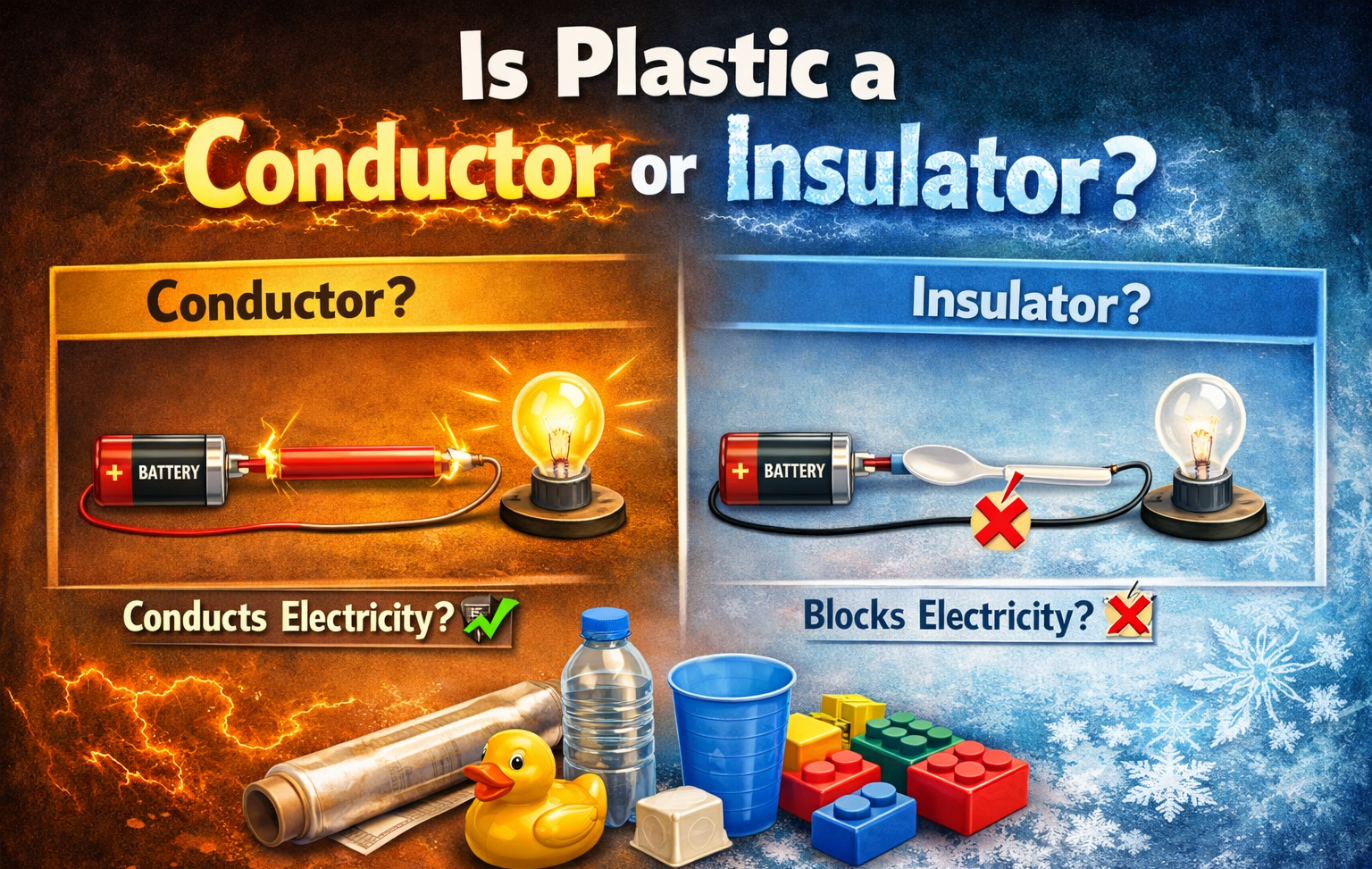
Educational Experiments Demonstrating: Is Plastic a Conductor or Insulator?
Simple classroom experiments confirm plastic’s insulating behavior:
- Connect a battery and light bulb.
- Insert a metal wire — bulb lights up.
- Insert a plastic rod — bulb does not light.
This basic test clearly shows that plastic does not conduct electricity.
Summary: Is Plastic a Conductor or Insulator?
After examining molecular structure, electrical resistance, real-life applications, conductive polymers, and scientific classification, we can confidently answer:
Plastic is an insulator.
While specialized conductive plastics exist, ordinary plastic materials do not allow electricity to flow.Final Conclusion: Is Plastic a Conductor or Insulator?
The question is plastic a conductor or insulator may seem simple, but it opens the door to fascinating scientific principles.
Plastic’s tightly bonded molecular structure prevents free electron movement. This makes it highly resistant to electrical flow. Because of this property, plastic is widely used in:
- Electrical insulation
- Safety equipment
- Electronic devices
- Industrial applications
Though scientists have developed conductive polymers for advanced technology, the plastic we use daily remains an insulator.
So the next time you plug in your charger or flip a switch, remember:
The silent protector around those wires is plastic — and it is proudly an insulator, not a conductor.
READ MORE: NEWZTOP.CO.UK
