



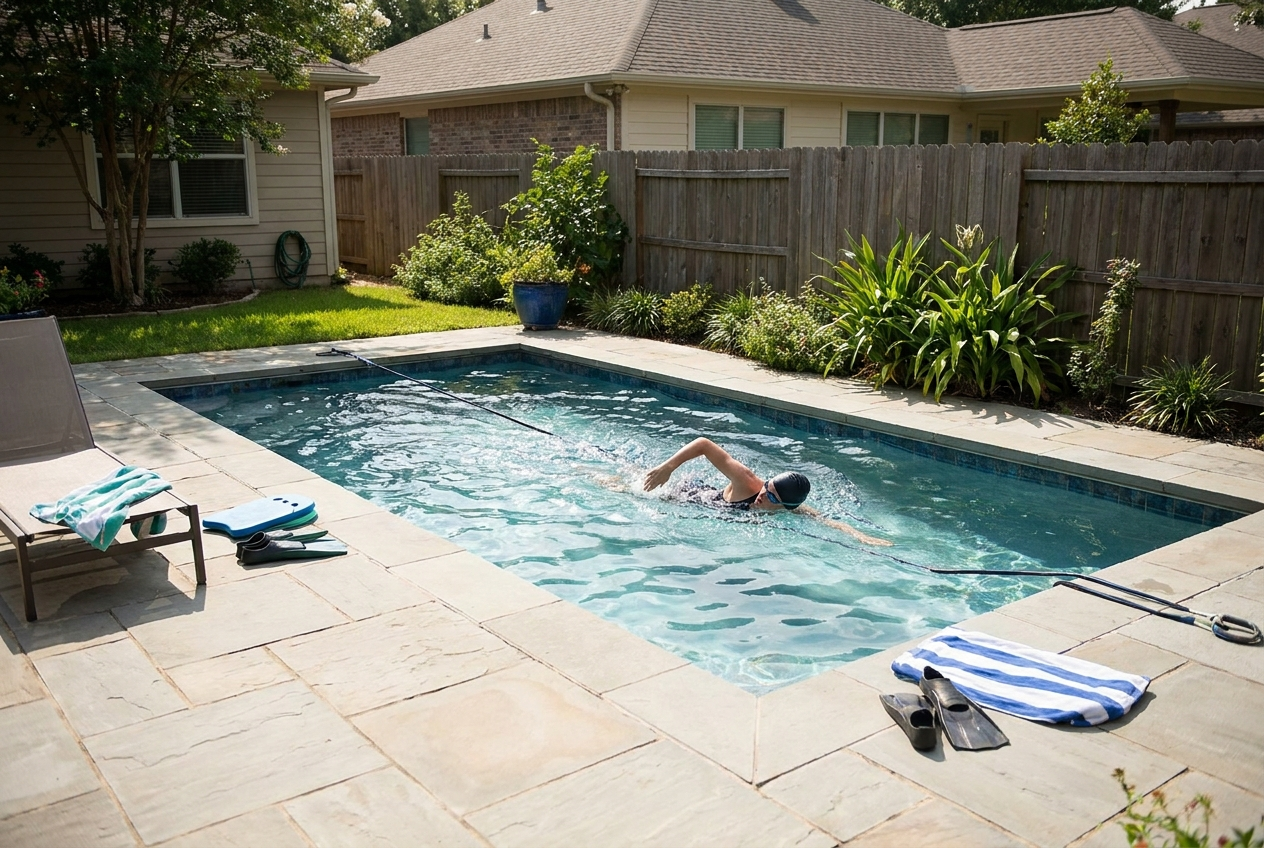
A small backyard pool can feel too short for real swimming. You push off, take a few strokes, and reach the wall. Then you turn again. This can break your rhythm. It can also make the workout feel more like stop-and-go movement than real lap swimming.
But you do not always need a bigger pool. You also do not need to rebuild your backyard. With the right method, a small pool can become a useful place for fitness, stroke practice, and steady swimming. The goal is not to copy a public lap pool. The goal is to make the pool you already have work better.
This starts with a few simple changes. Clear the swim area. Choose a training method. Use the right type of resistance. Build short sessions that are easy to repeat. When these parts work together, a small pool can support real progress.
Understand the Limits of a Small Pool
Most small backyard pools are made for relaxing, cooling off, and family use. They are not made for long, straight lap swimming. This does not mean they are useless for exercise. It only means you need to train in a different way.
In a short pool, normal laps can be frustrating. You may need to turn every few seconds. You may lose speed at each wall. Your breathing pattern may change too often. This makes it hard to build endurance.
A small pool also gives less room for drills. You may not have enough distance for full stroke work. If the pool has steps, benches, or curves, the usable swim lane may be even shorter.
Once you understand these limits, you can work around them. You can focus on swimming in place, resistance work, short intervals, and technique drills. These methods can make a small pool feel much more practical.
Clear One Main Swim Zone
Before adding any equipment, clean up the pool space. Pick the straightest and safest part of the pool. This will be your main swim zone.
Remove floats, toys, and loose items. Make sure steps and ledges are easy to see. Keep the water surface clear. If you use the pool at night, add enough lighting around the deck.
The swim zone does not need to be wide. But it should allow your arms and legs to move freely. You should not feel like you are hitting the wall or bumping into objects. A clean zone also makes training feel more focused.
This small step matters. If the pool looks messy, you may not want to train. If it looks ready, it becomes easier to use.
Use Swim-in-Place Training
Swim-in-place training is one of the best ways to use a small pool. Instead of moving from one end to the other, you stay in one area and swim against resistance.
There are a few ways to do this. Some swimmers use a swim tether. This is a strap or belt that holds the swimmer in place. It can be simple and low cost. But it may feel unnatural for some people. It can also pull on the body if the position is not right.
Another option is a portable swim current. This creates moving water in the pool. You swim against the current and stay in place. This can feel closer to normal swimming because your body moves through flowing water.
A compact water current can be helpful when you want lap-style training without changing the pool structure. For example, some homeowners compare options like i garden swim jet x air when they want to add swim resistance to an existing pool while keeping the backyard layout the same.
The best choice depends on your pool, fitness level, and budget. A beginner may only need light resistance. A stronger swimmer may need a more powerful current. The setup should also be easy enough to use often.
Practice Short Interval Sets
You do not need to swim for 30 minutes without stopping. Short interval sets work well in small pools. They also help you build endurance in a controlled way.
Start with a simple structure. Swim for 30 seconds. Rest for 30 seconds. Repeat this 10 times. This gives you a 10-minute main set. Add a short warm-up and cool-down, and you have a full session.
As you improve, extend the swim time. Try 45 seconds of swimming and 30 seconds of rest. Later, try one minute of swimming and 20 seconds of rest.
This method is easy to adjust. It also keeps your training from feeling boring. You can focus on smooth strokes during each work period. You do not need to worry about counting long laps.
Focus on Technique, Not Just Distance
In a small pool, distance is not always the best measure. Technique may matter more. Use the pool to improve body position, breathing, and stroke control.
Start with body balance. Keep your head low. Look slightly forward and down. Try to keep your hips near the surface. If your legs sink, slow down and relax your kick.
Next, work on breathing. Turn your head to the side without lifting it too high. Breathe calmly. Then return your face to the water. A small pool gives you a quiet place to repeat this movement many times.
You can also practice catch and pull. Move your hand into the water with control. Feel the water with your forearm. Pull back smoothly. Do not rush the stroke.
These details can improve your swimming even without long laps. A short pool can be a good place to learn because there are fewer distractions.
Add Kicking and Strength Work
A small pool is also useful for kicking sets. Hold the pool edge or use a kickboard. Kick for short periods. Rest when needed. Keep the movement steady and controlled.
You can also add water walking, side steps, and gentle resistance movements. These are good for low-impact fitness. They can help people who do not want hard swimming every day.
For a simple workout, mix swimming and non-swimming movements. Swim in place for one minute. Then do water walking for one minute. Then do easy kicking for one minute. Repeat the circuit several times.
This gives your body variety. It also makes the pool useful for different fitness levels.
Keep the Setup Easy to Repeat
The best training plan is the one you can repeat. Avoid making the setup too complicated. Store your swim gear near the pool. Keep goggles, towel, and timer in one place. If you use resistance equipment, make sure it is easy to set up and put away.
A routine is more important than a perfect workout. Three simple sessions per week can help more than one hard session that you never repeat.
You can also set a fixed time. Swim before breakfast. Train after work. Use Sunday morning for a longer session. The more regular it feels, the easier it becomes.
Make the Pool Comfortable Through the Year
If you want to swim more often, comfort matters. A pool cover can help keep the water cleaner and warmer. It can also reduce the time you spend removing leaves.
In cooler months, consider water temperature. You do not need warm spa water for training. But the water should be comfortable enough that you can move safely. If you are tense from cold water, your stroke will suffer.
Lighting also helps. Many people swim early or late. A safe deck and clear view of the water can make the pool more usable outside peak summer hours.
Know When Small Is Enough
A small pool will not become a full competition lane. That is fine. It can still support fitness, technique, and regular movement. You can swim against resistance. You can do intervals. You can practice breathing. You can build a habit.
The main benefit is access. Your pool is at home. You do not need to drive. You do not need to wait for a lane. You do not need a major renovation.
With a clear swim zone, simple gear, and a smart routine, a small pool can become a real training space. It may not give you traditional laps, but it can give you steady swimming. For many home swimmers, that is exactly what they need.
