



The aggregate demand curve is one of the most fundamental concepts in macroeconomics. It represents the total demand for goods and services in an economy at different price levels during a specific period. Understanding the aggregate demand (AD) curve is essential for analyzing economic fluctuations, inflation, unemployment, business cycles, and government policy decisions.
In simple terms, aggregate demand shows how much consumers, businesses, governments, and foreign buyers are willing to spend at various price levels. Economists rely heavily on this concept to explain economic growth, recessions, and recovery phases. Whether you are a student, policymaker, or someone interested in understanding how economies function, learning about the aggregate demand curve provides valuable insights into real-world economic behavior.
This article explores the aggregate demand curve in depth, including its definition, components, determinants, shifts, slope, mathematical representation, relationship with aggregate supply, and real-world applications.
What is the Aggregate Demand Curve?
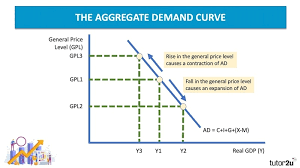
The aggregate demand curve is a graphical representation showing the relationship between the overall price level and the quantity of goods and services demanded in an economy.
It illustrates how total spending changes when the price level rises or falls, assuming other factors remain constant (ceteris paribus). The curve typically slopes downward from left to right, indicating an inverse relationship between price levels and total output demanded.
Aggregate demand combines the demand of all sectors of the economy, making it broader than individual demand curves used in microeconomics.
Components of Aggregate Demand
Aggregate demand is composed of four major components:
1. Consumption (C)
Consumption refers to household spending on goods and services such as food, clothing, healthcare, transportation, and entertainment. It is usually the largest component of aggregate demand in most economies.
Consumption depends on several factors:
- Disposable income
- Consumer confidence
- Interest rates
- Wealth levels
- Expectations about the future
When people feel financially secure, consumption increases, raising aggregate demand.
2. Investment (I)
Investment includes spending by businesses on capital goods such as machinery, buildings, equipment, and technology. It also includes residential construction and changes in inventories.
Investment decisions are influenced by:
- Interest rates
- Business expectations
- Economic growth prospects
- Government policies
- Technological innovation
Lower interest rates generally encourage investment because borrowing becomes cheaper.
3. Government Spending (G)
Government spending includes expenditures on infrastructure, education, defense, healthcare, public services, and social programs.
Unlike consumption and investment, government spending is largely determined by policy decisions rather than market forces. Governments often increase spending during economic downturns to stimulate aggregate demand.
4. Net Exports (X − M)
Net exports represent the difference between exports (goods sold abroad) and imports (goods purchased from other countries).
Net exports depend on:
- Exchange rates
- Global economic conditions
- Trade policies
- Domestic income levels
If exports exceed imports, net exports are positive and increase aggregate demand. If imports exceed exports, net exports reduce aggregate demand.
Aggregate Demand Formula
The aggregate demand formula is expressed as:
AD = C + I + G + (X − M)
Where:
- C = Consumption
- I = Investment
- G = Government Spending
- X = Exports
- M = Imports
This equation summarizes the total spending in an economy.
Why the Aggregate Demand Curve Slopes Downward
The aggregate demand curve slopes downward due to three primary effects:
1. Wealth Effect (Real Balance Effect)
When the price level falls, the purchasing power of money increases. Consumers feel wealthier and spend more, increasing demand.
Conversely, when prices rise, purchasing power declines, reducing consumption.
2. Interest Rate Effect
A lower price level reduces the demand for money, which lowers interest rates. Lower interest rates encourage borrowing and investment spending.
Higher price levels increase interest rates, discouraging investment and consumption.
3. Exchange Rate Effect
When domestic prices fall, exports become cheaper for foreign buyers, increasing demand for domestic goods. Imports become relatively expensive, reducing import demand.
This increases net exports and shifts aggregate demand upward.
Shifts in the Aggregate Demand Curve
The aggregate demand curve does not remain fixed. It shifts when factors other than price levels change.
Rightward Shift (Increase in Aggregate Demand)
Aggregate demand increases when:
- Consumer income rises
- Interest rates fall
- Government spending increases
- Taxes decrease
- Exports increase
- Business confidence improves
- Money supply increases
A rightward shift indicates economic expansion.
Leftward Shift (Decrease in Aggregate Demand)
Aggregate demand decreases when:
- Consumer income falls
- Interest rates rise
- Government spending decreases
- Taxes increase
- Exports decline
- Economic uncertainty increases
- Money supply decreases
A leftward shift indicates economic contraction.
Movement Along vs. Shift of the Curve
Understanding the difference between movement along the curve and shifts is crucial.
Movement Along the Curve
Occurs due to changes in the price level only.
Example: Inflation causing reduced purchasing power leads to movement along the curve.
Shift of the Curve
Occurs due to changes in external factors such as income, policies, or expectations.
Example: Government stimulus causing increased spending shifts the curve to the right.
Aggregate Demand and National Income
Aggregate demand plays a key role in determining national income and output levels.
When aggregate demand increases:
- Production rises
- Employment increases
- Income levels grow
When aggregate demand decreases:
- Production falls
- Unemployment rises
- Income declines
This relationship is central to macroeconomic theory.
Relationship Between Aggregate Demand and Aggregate Supply
Aggregate demand works together with aggregate supply to determine:
- Price levels
- Output levels
- Economic equilibrium
The intersection of aggregate demand and aggregate supply curves determines macroeconomic equilibrium.
If aggregate demand increases faster than aggregate supply, inflation may occur.
If aggregate supply grows faster than aggregate demand, deflation or unemployment may occur.
Short-Run vs Long-Run Aggregate Demand Effects
While the aggregate demand curve itself remains downward sloping in both short and long run, its impact varies over time.
Short Run
Changes in aggregate demand affect:
- Output
- Employment
- Prices
Economies may experience booms or recessions.
Long Run
In the long run, output depends more on productive capacity rather than demand alone. However, sustained demand growth can encourage investment and capacity expansion.
Role of Monetary Policy in Aggregate Demand
Central banks influence aggregate demand through monetary policy tools:
- Interest rate adjustments
- Open market operations
- Reserve requirements
- Money supply control
Lower interest rates increase borrowing and spending, boosting aggregate demand.
Higher interest rates reduce spending and control inflation.
Role of Fiscal Policy in Aggregate Demand
Governments use fiscal policy to influence aggregate demand through:
- Taxation
- Public spending
- Transfer payments
- Subsidies
Expansionary fiscal policy increases aggregate demand during recessions.
Contractionary fiscal policy reduces demand during inflationary periods.
Multiplier Effect and Aggregate Demand
The multiplier effect magnifies the impact of spending on aggregate demand.
For example:
Government spending on infrastructure creates jobs. Workers earn income and spend it, creating further economic activity.
The multiplier depends on the marginal propensity to consume (MPC).
Higher MPC results in a stronger multiplier effect.
Aggregate Demand and Business Cycles
Fluctuations in aggregate demand are a major cause of business cycles.
Economic Expansion
Rising consumption and investment increase aggregate demand, leading to growth.
Recession
Falling demand reduces production, causing unemployment and economic decline.
Recovery
Policy interventions and improved confidence increase aggregate demand again.
Factors Influencing Aggregate Demand
Several factors influence aggregate demand:
Consumer Expectations
If consumers expect higher future income, they spend more today.
Business Confidence
Optimistic firms invest more, increasing aggregate demand.
Global Economic Conditions
Strong global growth increases export demand.
Exchange Rates
Currency depreciation increases exports and aggregate demand.
Government Policies
Tax cuts and spending programs stimulate demand.
Mathematical Representation of Aggregate Demand Curve
Economists sometimes represent aggregate demand using equations such as:
Y = C(Y − T) + I(r) + G + NX(e)
Where:
- Y = National income
- T = Taxes
- r = Interest rate
- e = Exchange rate
- NX = Net exports
This equation shows how different variables interact to determine demand.
Importance of Aggregate Demand in Macroeconomics
The aggregate demand curve is important because it helps:
- Explain inflation and deflation
- Analyze unemployment
- Understand economic growth
- Guide government policy decisions
- Predict economic trends
- Evaluate monetary and fiscal policies
Without aggregate demand analysis, macroeconomic planning would be incomplete.
Real-World Examples of Aggregate Demand Changes
Economic Stimulus Programs
Government stimulus during recessions increases spending, shifting aggregate demand rightward.
Financial Crises
Banking crises reduce investment and consumption, shifting demand leftward.
Pandemic Effects
Global disruptions reduce consumer spending and investment, decreasing aggregate demand.
Limitations of the Aggregate Demand Concept
Despite its usefulness, aggregate demand has some limitations:
- Difficult to measure precisely
- Assumes constant factors (ceteris paribus)
- Ignores income distribution differences
- May oversimplify complex economic behavior
- Does not fully explain long-term growth alone
Economists therefore combine aggregate demand with other models.
Aggregate Demand vs Individual Demand
Aggregate demand differs from individual demand in several ways:
| Individual Demand | Aggregate Demand |
|---|---|
| Focuses on one good | Focuses on entire economy |
| Microeconomic concept | Macroeconomic concept |
| Based on individual preferences | Based on national spending |
| Simpler analysis | Complex interactions |
Policy Implications of Aggregate Demand
Understanding aggregate demand helps policymakers:
- Control inflation
- Reduce unemployment
- Stabilize economic cycles
- Promote sustainable growth
- Manage public debt
- Improve living standards
Effective policy depends on accurate demand analysis.
Common Misconceptions About Aggregate Demand
Misconception 1: Higher Demand Always Means Higher Prices
Not necessarily. If supply increases simultaneously, prices may remain stable.
Misconception 2: Government Spending Always Improves Economy
Excessive spending may cause inflation or debt problems.
Misconception 3: Interest Rates Only Affect Investment
Interest rates also affect consumption, exchange rates, and expectations.
Graphical Representation of Aggregate Demand Curve
The aggregate demand curve typically shows:
- Price level on the vertical axis
- Real GDP on the horizontal axis
- Downward sloping curve
Shifts indicate economic changes, while movement along the curve reflects price changes.
Aggregate Demand in Developing Economies
In developing countries, aggregate demand behaves differently due to:
- Lower income levels
- Informal sectors
- Limited financial markets
- Dependence on exports
- Government policy constraints
Policies must therefore consider structural differences.
Future Trends and Aggregate Demand
Modern economies are experiencing new influences on aggregate demand:
- Digital transformation
- Globalization shifts
- Demographic changes
- Automation and AI
- Climate policies
- Supply chain restructuring
These factors continue to reshape demand patterns worldwide.
Conclusion
The aggregate demand curve is a cornerstone of macroeconomic analysis. It provides a comprehensive framework for understanding how total spending in an economy responds to price changes and external influences. By combining consumption, investment, government spending, and net exports, aggregate demand reflects the overall economic activity of a nation.
The downward slope of the aggregate demand curve results from wealth effects, interest rate changes, and exchange rate movements. Shifts in the curve occur due to policy decisions, economic expectations, and global conditions. Policymakers use aggregate demand analysis to manage inflation, unemployment, and economic growth.
Although the concept has limitations, it remains one of the most powerful tools for analyzing economic fluctuations and guiding policy decisions. Understanding aggregate demand enables individuals, businesses, and governments to make better economic decisions and prepare for future challenges.
In a rapidly changing global economy, the aggregate demand curve continues to play a vital role in shaping economic theory and practice, making it an essential topic for anyone interested in economics.
READ MORE: NEWZTOP.CO.UK
