



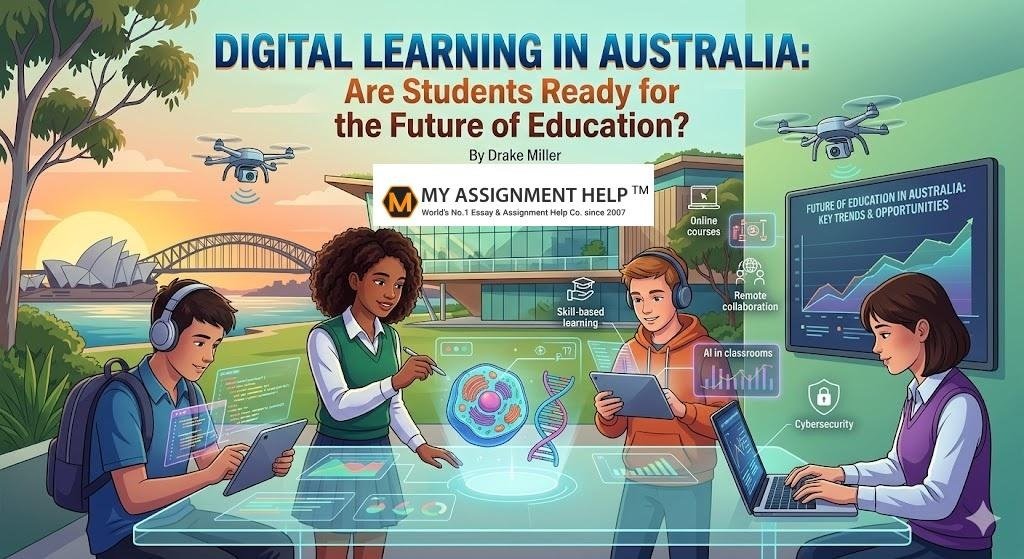
The landscape of Australian education is undergoing a seismic shift that transcends mere classroom technology. From the bustling, high-tech lecture theatres of the University of Melbourne and UNSW to the remote, satellite-linked classrooms of the Northern Territory, the traditional “chalk and talk” method is rapidly being replaced by pixels, platforms, and sophisticated algorithms. As we navigate the mid-2020s, the central question for the Australian Commonwealth is no longer when digital learning will arrive, but whether Australian students—from Year 11 and 12 secondary students to postgraduates—are truly prepared for the tech-heavy future of education and the 2027 job market.
The Digital Evolution of the Australian Classroom
Australia has long been an early adopter of educational technology. The “Digital Education Revolution” initiated over a decade ago laid the groundwork, but the global events of the early 2020s accelerated the timeline by years. Today, digital learning is not just an “extra”; it is the core infrastructure of the Australian curriculum.
For senior secondary students in Australia, this means more than just using a laptop; it involves navigating complex Learning Management Systems (LMS) like Canvas, Moodle, or Compass. These platforms are now the primary gateway for submitting assessments that determine a student’s ATAR (Australian Tertiary Admission Rank). For university students, the stakes are even higher, involving AI-integrated research tools, virtual laboratories, and global collaborative databases. Many students navigating these high stakes often turn to online assignment services to ensure their digital submissions meet the rigorous formatting and technical standards required by modern universities.
However, a critical distinction must be made: being “tech-savvy” on social media does not automatically translate to “digital literacy” or “academic readiness” in a high-pressure educational context.
The Skill Gap: Social Proficiency vs. Academic Literacy
There is a common misconception among policymakers and parents that because Gen Z and Gen Alpha are “digital natives,” they are inherently ready for the future of education. While most Australian students can navigate a smartphone with their eyes closed, academic digital readiness requires a sophisticated set of “Agentic” skills.
1. Information Literacy
In an era of deepfakes and AI-generated misinformation, the ability to discern credible sources is a survival skill. Students must now understand the principles of Experience, Expertise, Authoritativeness, and Trustworthiness (E-E-A-T). Whether a student is writing an essay for their HSC (Higher School Certificate) in NSW or a research paper at ANU, they must be able to move beyond a basic Google search to identify peer-reviewed, ethically sourced data. This is where the ROI of high-quality writing becomes apparent; the ability to synthesize complex data into a coherent argument is a premium skill in the 2027 economy.
2. Digital Collaboration and the Hybrid Workforce
The Australian workforce is moving toward a permanent hybrid model. To be “future-ready,” students must master professional collaborative tools like Slack, Trello, and Google Workspace. Group projects in Australian universities are increasingly conducted across time zones, requiring students to manage digital workflows and asynchronous communication—skills that are directly transferable to careers in Sydney’s tech hubs or Melbourne’s financial district.
3. Cognitive Self-Regulation and Deep Work
The digital world is designed to distract. The transition from a supervised, face-to-face classroom to an autonomous, online-heavy environment requires immense discipline. Digital minimalism and structured focus techniques, such as Cal Newport’s Deep Work methodology or time-blocking, are becoming essential components of the modern Australian study routine. Without these, the cognitive load of constant notifications can lead to rapid burnout, particularly during the grueling VCE or HSC exam periods.
The Rise of AI and “Agentic Literacy” in Australian Higher Ed
One of the most significant shifts in Australian education is the integration of Artificial Intelligence. Rather than the reactionary bans seen in early 2023, Australian universities and the Tertiary Education Quality and Standards Agency (TEQSA) are moving toward a framework of “AI Fluency” and “Agentic Literacy.”
Students are now being taught to use AI as a “co-pilot” for brainstorming, data analysis, and structural outlining. This shift is crucial because the future job market in Australia—spanning healthcare, engineering, and renewable energy—will demand professionals who can work alongside AI. However, the risk of “outsourcing thought” remains. The goal is to ensure students remain the “agents” of their own learning, using technology to enhance, rather than replace, critical thinking.
For students feeling overwhelmed by these rapid changes, seeking expert human guidance is a natural part of the learning process. Mastering new software or understanding complex digital rubrics can be daunting. If you are studying in South Australia and struggling to balance these digital demands with your coursework, utilizing professional assignment help Adelaide can provide the necessary scaffolding. We offer expert insights that help students bridge the gap between traditional rote learning and the complex digital demands of modern Australian degrees.
The “Digital Divide”: A Geographic and Socioeconomic Challenge
We cannot discuss readiness without addressing equity. Australia’s vast geography creates a unique challenge. While a student in metropolitan Sydney or Brisbane might have high-speed NBN and the latest hardware, those in regional and rural Australia often face “digital poverty.”
The “Future of Education” is only bright if it is inclusive. While the Australian government is investing in regional digital hubs, the gap in infrastructure remains a hurdle for many. For a student in a remote town in Western Australia, “readiness” is often dictated by their internet bandwidth rather than their intellectual capacity. True readiness for the nation means ensuring that a student’s postcode does not determine their level of digital literacy. As we move toward 2030, the ROI of academic skills must be accessible to all, regardless of their proximity to a capital city.
Mental Health and Digital Fatigue: The Psychological Readiness
An often-overlooked aspect of digital learning readiness is the psychological impact. The isolation of remote learning has taken a significant toll on the mental health of Australian students. “Zoom fatigue” is real, and the lack of physical campus life can lead to a sense of academic detachment.
The future of Australian education must prioritize a “Blended Approach.” This model combines the flexibility and efficiency of online modules with the irreplaceable social and emotional benefits of face-to-face interaction. Students are ready for the tools of the future, but they still require the human connection of the past to thrive. Resilience in the face of digital saturation is perhaps the most important “soft skill” a student can develop today.
How Students Can Prepare for the 2030 Horizon
If you are a student in Australia today, ensuring you aren’t left behind requires a proactive strategy that moves beyond basic technical competency:
- Master “Un-Googleable” Skills: Focus on emotional intelligence, ethics, and complex problem-solving. These are the areas where human graduates will always outperform machines.
- Build a Digital Portfolio: The traditional resume is evolving. Start documenting your projects, coding repositories, or digital designs on platforms like LinkedIn or GitHub to show “proof of skill” to prospective Australian employers.
- Adhere to Local Standards: Understand the specific requirements of the Australian landscape, from APA7 or Harvard referencing to the nuances of the ATAR system.
- Embrace Lifelong Learning: View your degree as the start of a journey. The skills you learn today will likely require a “top-up” every few years as technology evolves.
The Role of Support Systems in a High-Pressure Era
As academic requirements become more complex and digitally driven, the pressure on students increases exponentially. The demand for high-quality, original research and perfectly formatted digital submissions—often requiring proficiency in software like LaTeX or advanced Excel—is at an all-time high. In this environment, professional academic support plays a vital role in maintaining student well-being and academic integrity.
By providing expert insights into complex topics and helping students structure their digital assignments to meet rigorous Australian standards, Myassignmenthelp.services act as a bridge. They ensure that the “Future of Education” doesn’t become a source of burnout, but rather a platform for success. This type of support allows students to focus on deep learning while mastering the technicalities of modern academic output, ensuring they remain competitive in an increasingly globalized job market.
Conclusion: Are Australian Students Ready?
The answer to whether Australian students are ready for the future of education is a “cautious yes.” The technical infrastructure is evolving, and the appetite for innovation among the youth is high. However, the true measure of readiness will be our ability to foster critical thinking, bridge the regional digital divide, and ensure that no student is left in the digital dark.
The future of Australian education isn’t just about faster computers or smarter AI—it’s about empowering students to use those tools to solve the real-world problems of tomorrow, ensuring that the human element remains at the heart of every digital classroom. As we look toward the 2027 economy, it is the combination of digital proficiency and traditional academic rigor that will define the next generation of Australian leaders.
Frequently Asked Questions
Q.1 How does digital literacy affect a student’s ATAR in Australia?
While digital literacy isn’t a standalone subject, it is the vehicle through which all assessments are delivered. Proficiency in using Research Databases, Learning Management Systems (LMS), and digital formatting tools ensures that students can submit high-quality work on time. Poor digital skills can lead to technical errors, lost marks on formatting, or inability to access key resources, indirectly impacting the final ATAR score.
Q.2 What is “Agentic AI” and why should Australian students care?
Agentic AI refers to AI systems that can take proactive steps to help a user achieve a goal, rather than just generating text. For students, this means using AI as a sophisticated research assistant. Understanding “Agentic Literacy” is crucial because the 2027 Australian job market will prioritize graduates who know how to direct and audit AI outputs rather than those who simply let AI do the work for them.
Q.3 Is using academic help services from Myassignmenthelp.services considered ethical in the digital age?
Yes, when used as a “scaffolding” tool. Ethical academic support focuses on providing model papers, expert research, and structural guidance. Just as a student might use a tutor or a writing center, these platforms help students understand complex digital rubrics and referencing standards (APA7, Harvard, etc.), ensuring they learn the “how” behind high-level academic production.
Q.4 How can students in regional Australia overcome the “Digital Divide”?
Students in regional areas should look into government-funded Regional University Study Hubs (formerly Regional Study Centres). These hubs provide high-speed internet, modern facilities, and a quiet study space. Additionally, mastering “offline” productivity skills and utilizing “low-bandwidth” versions of educational software can help manage connectivity issues.
Q.5 How do I manage “Digital Fatigue” during exam seasons like the HSC or VCE?
Managing fatigue requires a “Digital Minimalism” approach. Students are encouraged to use time-blocking—setting specific windows for online research and “analog” windows for handwritten notes or physical reading. This “Blended Study” method reduces eye strain and prevents the cognitive overload associated with constant screen time.
About the Author – Drake Miller
I am a dedicated blog author associated with Myassignmenthelp.services, focused on creating clear, engaging, and informative content for students. My work highlights academic success, practical study strategies, and simplified learning across subjects. I aim to make complex topics easy to understand while helping learners achieve their goals with confidence through well-researched and student-friendly writing.
