



Integration is one of the most important topics in calculus, and integration by parts is a powerful technique that allows us to solve integrals that cannot be computed directly. In this article, we will explore integration by parts examples in depth, explain the theory behind them, and provide practical applications.
What is Integration by Parts?
Integration by parts is a technique derived from the product rule of differentiation. integration by parts examples It allows you to integrate the product of two functions by splitting them into parts that are easier to handle.
The formula for integration by parts is:∫udv=uv−∫vdu
Where:
- u is a function chosen for differentiation integration by parts examples ,
- dv is the remaining part of the integrand chosen for integration,
- du is the derivative of u, integration by parts examples and
- v is the integral of dv.
This method is especially useful when integrating products of algebraic, integration by parts examples exponential, logarithmic, and trigonometric functions.
How to Choose u and dv
One of the key steps in integration by parts is choosing u and dv. integration by parts examples A common mnemonic to help with this is LIATE:
- L — Logarithmic functions (lnx, logx)
- I — Inverse trigonometric functions (arctanx, arcsinx)
- A — Algebraic functions (x2,x3)
- T — Trigonometric functions (sinx,cosx)
- E — Exponential functions (ex,2x)
Choose u as the function that appears earlier in LIATE, and dv as the remaining part.
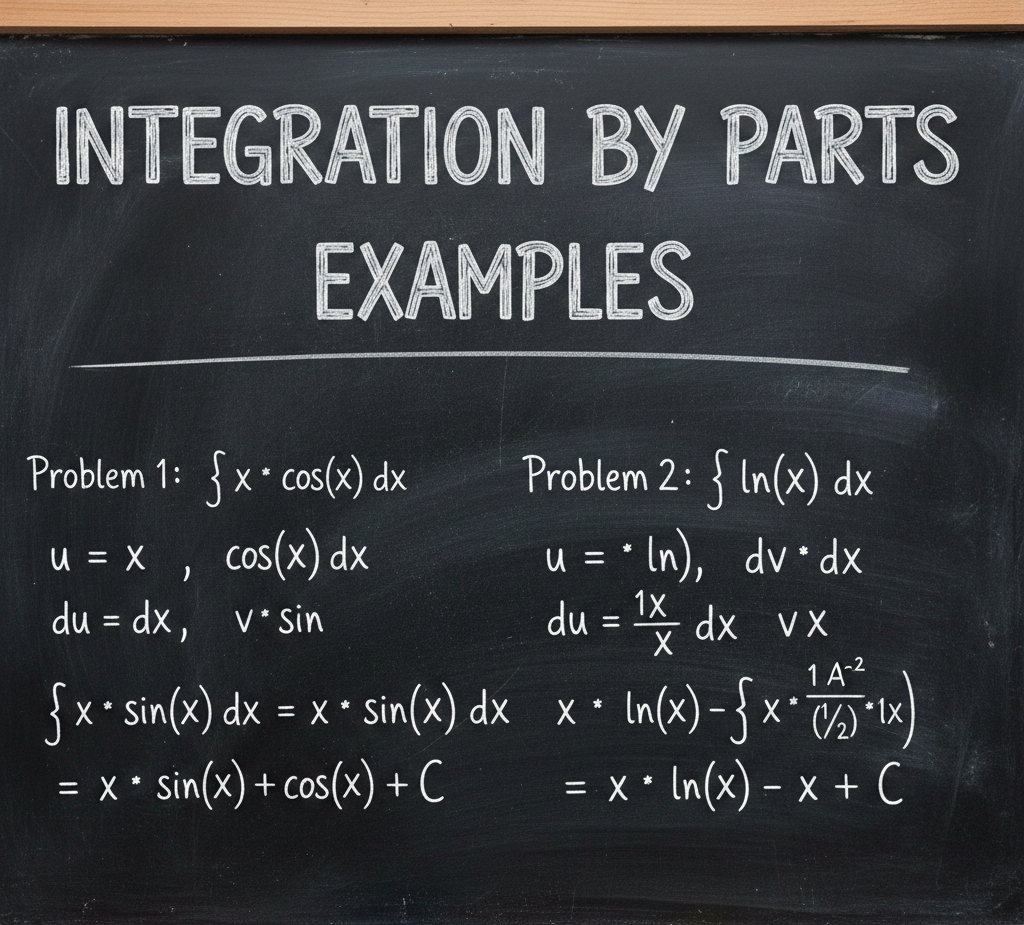
Integration by Parts Examples: Step-by-Step
Example 1: ∫xexdx
Step 1: Identify uuu and dvdvdv
- u=x (algebraic, easier to differentiate)
- dv=exdx (exponential, easy to integrate)
Step 2: Compute dududu and vvv
- du=dx
- v=∫exdx=ex
Step 3: Apply the formula∫xexdx=uv−∫vdu∫xexdx=xex−∫exdx∫xexdx=xex−ex+C
✅ Final Answer: xex−ex+C
Example 2: ∫lnxdx
At first glance, integration by parts examples this seems tricky because it is not a product. But we can still use integration by parts.
Step 1: Rewrite as a product∫lnxdx=∫lnx⋅1dx
Step 2: Choose uuu and dvdvdv
- u=lnx (logarithmic, earlier in LIATE)
- dv=dx
Step 3: Compute dududu and vvv
- du=x1dx
- v=∫dx=x
Step 4: Apply the formula∫lnxdx=uv−∫vdu∫lnxdx=xlnx−∫x⋅x1dx∫lnxdx=xlnx−∫1dx∫lnxdx=xlnx−x+C
✅ Final Answer: xlnx−x+C
Example 3: ∫x2cosxdx
Step 1: Choose uuu and dvdvdv
- u=x2 (algebraic, easier to differentiate)
- dv=cosxdx
Step 2: Compute dududu and vvv
- du=2xdx
- v=∫cosxdx=sinx
Step 3: Apply the formula∫x2cosxdx=uv−∫vdu∫x2cosxdx=x2sinx−∫sinx⋅2xdx∫x2cosxdx=x2sinx−2∫xsinxdx
Here, we need integration by parts again for ∫xsinxdx.
Step 4: Apply integration by parts again
- u=x, dv=sinxdx
- du=dx, v=−cosx
∫xsinxdx=−xcosx+∫cosxdx=−xcosx+sinx
Step 5: Substitute back∫x2cosxdx=x2sinx−2(−xcosx+sinx)∫x2cosxdx=x2sinx+2xcosx−2sinx+C
✅ Final Answer: x2sinx+2xcosx−2sinx+C
Example 4: ∫exsinxdx
Step 1: Choose uuu and dvdvdv
- u=sinx
- dv=exdx
Step 2: Compute dududu and vvv
- du=cosxdx
- v=ex
Step 3: Apply the formula∫exsinxdx=uv−∫vdu∫exsinxdx=exsinx−∫excosxdx
Now, we encounter ∫excosxdx, which also requires integration by parts.
Step 4: Apply again
- Let u=cosx, dv=exdx
- du=−sinxdx, v=ex
∫excosxdx=excosx−∫ex(−sinx)dx∫excosxdx=excosx+∫exsinxdx
Notice the original integral appears again. Let I=∫exsinxdx.I=exsinx−(excosx+I)I=exsinx−excosx−I2I=ex(sinx−cosx)I=2ex(sinx−cosx)+C
✅ Final Answer: 2ex(sinx−cosx)+C
Example 5: ∫xlnxdx
Step 1: Choose uuu and dvdvdv
- u=lnx (logarithmic)
- dv=xdx (algebraic)
Step 2: Compute dududu and vvv
- du=x1dx
- v=∫xdx=2×2
Step 3: Apply the formula∫xlnxdx=uv−∫vdu∫xlnxdx=2×2lnx−∫2×2⋅x1dx∫xlnxdx=2×2lnx−∫2xdx∫xlnxdx=2×2lnx−4×2+C
✅ Final Answer: 2×2lnx−4×2+C
Tips for Solving Integration by Parts Problems
- Always simplify the integral as much as possible before applying the formula integration by parts examples .
- Use LIATE to choose u correctly. integration by parts examples
- For repeated integrals (like ∫exsinxdx), integration by parts examples assign the integral a variable and solve algebraically integration by parts examples.
- Practice on different types of functions: polynomials, integration by parts examples exponentials, logs, and trigonometric products integration by parts examples .
- Verify your solution by differentiating the final answer. integration by parts examples It should give the original integrand.
Applications of Integration by Parts
Integration by parts is not just a classroom exercise; it has practical applications:
- Physics: Computing work done by variable forces integration by parts examples .
- Engineering: Solving differential equations in circuits.
- Economics: Finding areas under curves for cost and revenue functions.
- Probability & Statistics: Calculating expected values for continuous distributions.
Common Mistakes to Avoid
- Forgetting the negative sign when differentiating trigonometric functions like cosx or sinx.
- Choosing u poorly, making the integral more complicated.
- Not including the constant of integration C.
- Forgetting that sometimes you may need integration by parts twice or more.
Practice Problems with Solutions
- ∫xe−xdx
- ∫arctanxdx
- ∫x3lnxdx
- ∫excosxdx
- ∫x2exdx
✅ Solutions can be derived using the techniques outlined above.
Conclusion
Integration by parts is an essential tool in calculus, allowing you to tackle integrals that otherwise seem impossible. Through careful selection of u and dv, repeated application, and understanding the theory, you can solve a wide variety of integrals. Mastery of integration by parts examples is a step toward greater fluency integration by parts examples in mathematics and its real-world applications integration by parts examples .
By practicing these examples and exploring different combinations of functions, students can build confidence in their integration skills and handle more complex problems with ease
READ MORE: NEWZTOP.CO.UK
